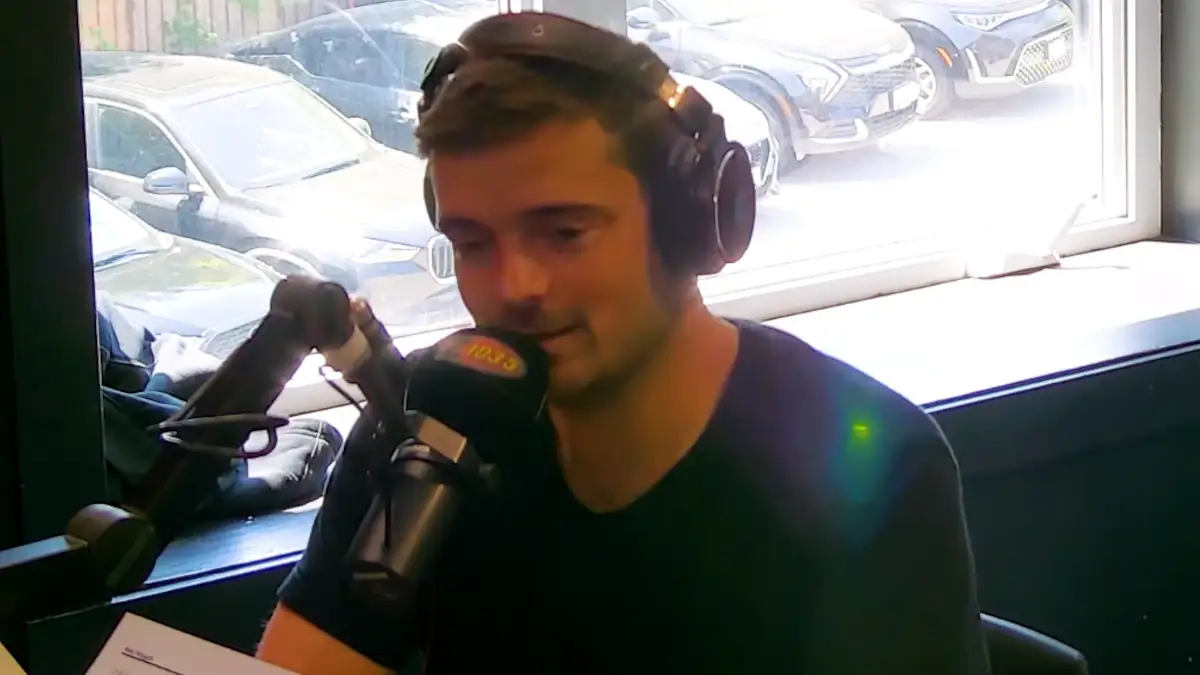
From Veld to Sold Out: Ten Years in One Conversation
The last time Garrix sat in this studio, he’d played Veld Music Festival on an early slot and wasn’t sure anyone would show up. He was seventeen. People came running over the hill anyway.
That was 2014. Tonight he’s at RBC Amphitheatre for the first of three sold-out Toronto dates — part of the America’s Tour, his largest North American run. Over 40,000 tickets sold in this city alone. Three nights at Barclays Center in New York. The full touring rig came in on trucks from Minneapolis. A lot has changed.
What hasn’t: he still does radio.
The Song That Two Record Labels Almost Killed
Ten years. That’s how long “Repeat It” — the Martin Garrix and Ed Sheeran collaboration that finally dropped this year — spent in limbo.
The original demo existed in 2015. Garrix played it at Ultra Miami. Then both artists were signed to labels, and the labels spent the next several years not quite making it work. Release schedules. Conflicts. At some point the song was quietly shelved, with no announcement and presumably no particular regret from anyone except the people who’d heard it and kept requesting it.
They’d run into each other on tour. “We should really finish a song,” one of them would say. They never did.
Last year in Los Angeles, Garrix was pulling material for the new album and “Repeat It” kept coming up — it had spent years as one of his most-requested unreleased tracks. He rebuilt it. Less electronic than the 2015 version, heavier on acoustic guitar, closer to what a Garrix-Sheeran record probably should have sounded like the first time. He sent it. Sheeran replied that he’d been thinking about the exact same song the previous week.
Then in Santiago, Chile, Sheeran walked on stage mid-set without a word to anyone. The crowd had no idea he was even in the country.
It’s a great story. It’s also a mild indictment of how major-label deal-making operates, though neither of them put it that way.
He’d Play It at a Campfire. That’s Not a Throwaway Line.
The most interesting thing Garrix said in the interview — and the thing easiest to dismiss as an EDM artist saying the expected thing — was that melody beats the drop. Every time, no contest.
His argument is more specific than it sounds. A song worth making should hold up on an acoustic guitar next to a campfire. If the chords and the feeling work without any production around them, you can build it into anything: a rock track, a festival anthem, a ballad. The production is downstream of the writing. Given his catalog — which has always leaned melodic even at peak energy — this isn’t posturing.
Two and a half hours is how long his own shows run. Festivals give him sixty minutes to hit as hard as possible, back to back with the next DJ. His own stage lets him go quieter before the next drop, build it back up, shape something with a beginning and a middle. The runtime matters to him more than the capacity numbers. That came through clearly.
Join the Most Exclusive Club in EDM

The One That Still Gets Him
“High on Life” came up without much prompting. He’s seen proposals happen during that song at live shows. People have folded it into some of the larger moments of their lives, which is an odd thing to know about something you made. He’s working on an acoustic version — planning to release it this year — which is either a beautiful idea or a genuine risk depending on how attached you are to the original.
The other track he mentioned isn’t his: Avicii’s “Levels.” He said there are moments mid-set when the goosebumps just arrive. He’s not expecting them. That one still does it, every time.
That landed differently than anything else in the interview.
Amsterdam, Studio Mode, and the Sister With the Soup
He produces in Amsterdam. His sister lives in the same building, which turns out to be a practical arrangement: when the studio light is on and she hasn’t heard from him, she comes by with soup, because she knows he forgets to eat.
That’s the whole detail. But it’s a better picture of how this music actually gets made than anything about crowd figures or touring rigs. You disappear. You forget to eat. Eventually something good comes out of it. He described the studio as therapy — not in the press-release sense, but in the sense that he can walk in and lose track of time entirely, coming out three days later genuinely unsure when it got dark.
His dream collaboration, incidentally, is Daft Punk. He said it like he already knows it won’t happen. That somehow made it more honest than anything else he said.
Frequently Asked Questions About Martin Garrix
The interview covered his America’s Tour, the decade-long backstory behind “Repeat It” with Ed Sheeran, his album-in-progress, his production philosophy (melody over drop, always), and his relationship to songs like “High on Life” — including an unannounced acoustic version he plans to release this year.
The original demo was recorded in 2015 and played publicly at Ultra Miami before label conflicts shelved it for nearly a decade. Garrix rebuilt the track last year with a more acoustic-leaning production and sent it to Sheeran, who happened to have been thinking about the same song that week. Sheeran later appeared unannounced on stage with Garrix in Santiago, Chile to perform it.
Garrix described it as feel-good and nostalgic in spirit. He’s released “Kathina” and “Repeat It” so far, with two or three more singles expected before the full album drops. He mentioned recording with artists he’s admired for years — some of them idols.
It’s Garrix’s independent label, marking its 10th anniversary this year. Beyond releasing music, STMPD runs city-takeover events, afterparties, and festival stage takeovers. Garrix has said it’s kept him from feeling alone in the industry.
Be Part of the EDM Lifestyle

There’s More to Read
Night Streak covers the artists, events, and culture that make up the global EDM scene — not just the headliners but the producers, the movements, the music that doesn’t always make the festival posters. Browse more artist profiles and follow where the sound is going. And when you’re at the show: #NightStreak.
